Loaded
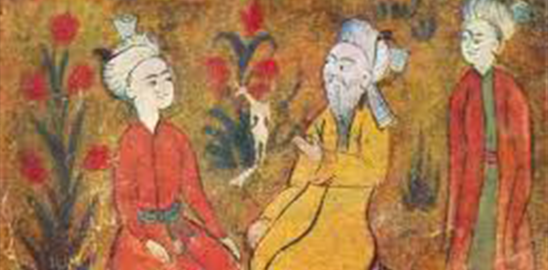
The Saami lineage begins with Hazrat Amir Khusro, the 13th-century Sufi mystic, poet, and composer credited with weaving Persian, Turkic, Arabic, and South Asian traditions into a singular, transformative musical tapestry. His foremost and only disciple, Mian Saamat bin Ibrahim (Yahya), became the first in a line of hereditary musicians devoted to carrying Khusro’s teachings forward. From this bond emerged the Qawwal Bachon ka Delhi Gharana—the only qawwali and khayal gharana that, for eight centuries, has made music a vessel of faith and spiritual devotion.
The Qawwal Bachon ka Delhi Gharana nurtured generations of musicians who safeguarded and expanded Khusro’s legacy. Among its luminaries was Ustaad Mian Tanrus Khan, chief court musician to Bahadur Shah Zafar, the last Mughal emperor. Over centuries, this gharana shaped and refined khayal, qawwali, tarana, and bandish, preserving the delicate balance of technical mastery and spiritual depth. Through disciplined oral transmission, the gharana maintained music as both scholarship and a living path to divine love.
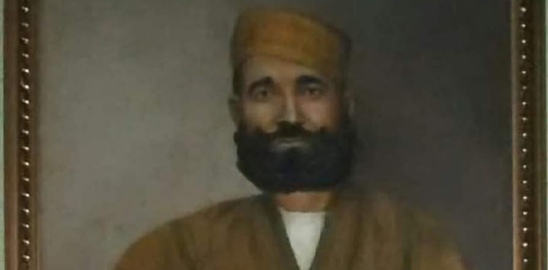
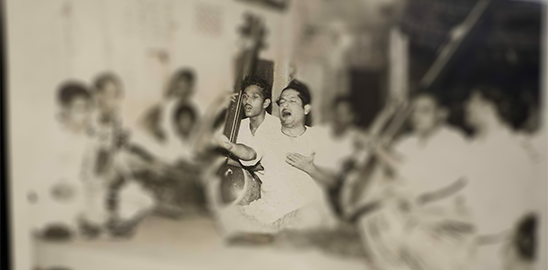
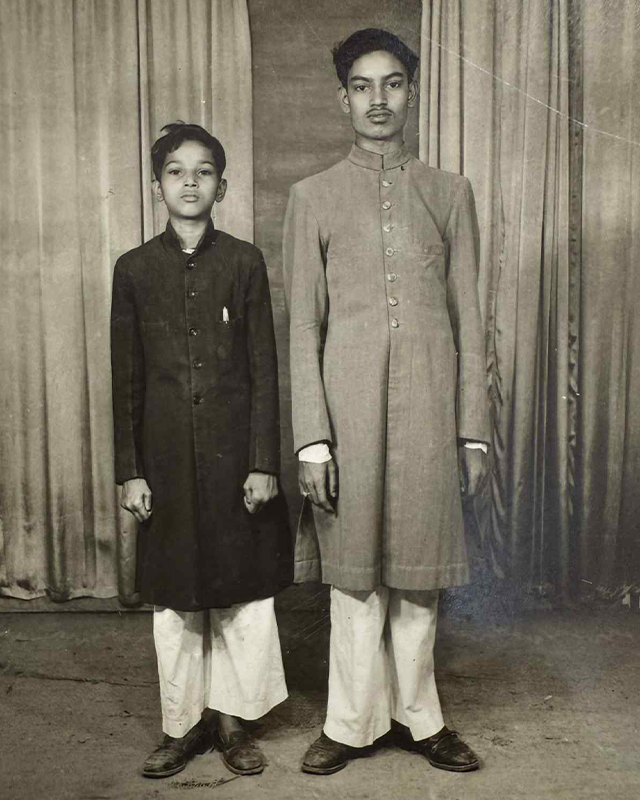
In the 20th century, the gharana’s torch passed to Ustaad Munshi Raziuddin Khan, a revered vocalist and teacher who dedicated his life to preserving Khusro’s legacy. Under his rigorous guidance, Ustaad Naseeruddin Saami (Jaan) trained extensively, embodying the rare 49-note microtonal system unique to this lineage. Today, he is recognized as a living treasure of South Asian classical music, both innovator and custodian of a tradition that spans centuries yet remains profoundly relevant.
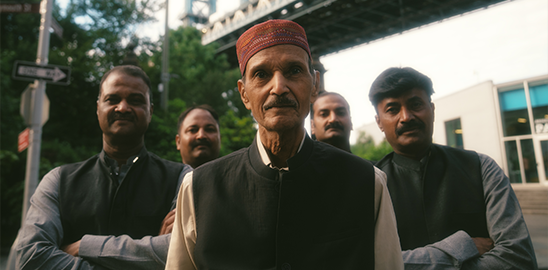
After Partition, the family of the Qawwal Bacha or Tanras Khan Sahab’s Delhi Gharana found new ground in Karachi. With the birth of Pakistan, this lineage carried its sacred inheritance across borders, planting and nurturing it in a new land until it blossomed again. Its flowering lives on today in Ustaad Naseeruddin Saami, whose voice is both root and renewal. Under his guidance, his sons—Rauf, Urooj, Azeem, and Ahmed—carry the tradition forward, linking centuries of devotion to the hearts of present generations.
Ustaad Saami and Sons have been actively working in the USA and around the world to expand the reach of khayal and qawwali, preserving their rich spiritual and musical heritage while introducing these profound traditions to new global audiences through workshops, panels, demos, University residencies and public performances in the US, Canada, Middle East and beyond.